aiiStudio


You are a senior brand designer, logo designer, visual art director, and editorial layout designer.

Based on the brand information I provide, directly design and generate a four-image brand visual identity proposal for the same brand. Do not output image prompts first, and do not only provide a proposal or page outline. Directly generate four separate images.

Brand information:

Chinese brand name: [fill in]
English brand name: [fill in]
Brand industry: [fill in]
Main product or service: [fill in]
Brand positioning and target audience: [fill in]
Core brand concept: [fill in]
Brand personality keywords: [fill in 3 to 5]
Brand slogan: [fill in, or refine based on the concept]

Logo inspiration source: [fill in]
Logo type: [abstract symbol / Chinese character fusion / letter graphic / geometric symbol / badge, etc.]
Meaning the logo should express: [fill in]
Elements that should not appear: [fill in]

Overall visual style: [fill in]
Primary color palette: [fill in]
Secondary and accent colors: [fill in]
Main materials: [fill in 3 to 5]
Photography or spatial atmosphere: [fill in]
Main products, packaging, and application scenarios: [fill in]

Aspect ratio: [default 4:5 vertical]
Text language: [mainly Chinese / mainly English / Chinese-English mix]
Additional requirements: [fill in]

If some information is missing, automatically supplement a reasonable solution based on the brand industry, positioning, and concept. Do not stop because non-critical fields are blank.

Design task:

First design and lock a unified brand system, including:

- An original, clear logo mark that can be used independently
- Chinese and English wordmarks
- Primary, secondary, and accent colors
- Typography, materials, and photography language
- Supporting graphics and patterns extended from the logo
- Product, packaging, collateral, and spatial applications

The logo cannot be pure text only. It must include a well-designed independent symbol related to the brand concept, with a clear silhouette, negative space, or geometric structure. It must remain recognizable when scaled down and be suitable for embossing, foil stamping, embroidery, engraving, and spatial signage.

Avoid directly using ordinary industry icons such as incense burners, tea leaves, female profiles, houses, common leaves, lotus flowers, auspicious clouds, taiji symbols, or traditional seals. These elements must be abstracted, simplified, and recomposed into an original brand symbol.

Once the logo is determined, the core outline, internal structure, wordmark, and combinations must remain consistent across all four images. Do not redesign the logo separately in each image.

Four image contents:

Image 1: Brand worldbuilding and concept cover.
Use a large brand key visual to establish the brand mood and world, while clearly showing the full logo, Chinese name, English name, concept title, brand manifesto, 3 to 5 mood or material images, and a small number of handwritten concept notes.
Use a structure of large headline plus large key visual plus full logo plus irregular mood collage. The logo must be clearly visible, but must not overpower the main title or brand atmosphere.

Image 2: Logo concept and symbol generation logic.
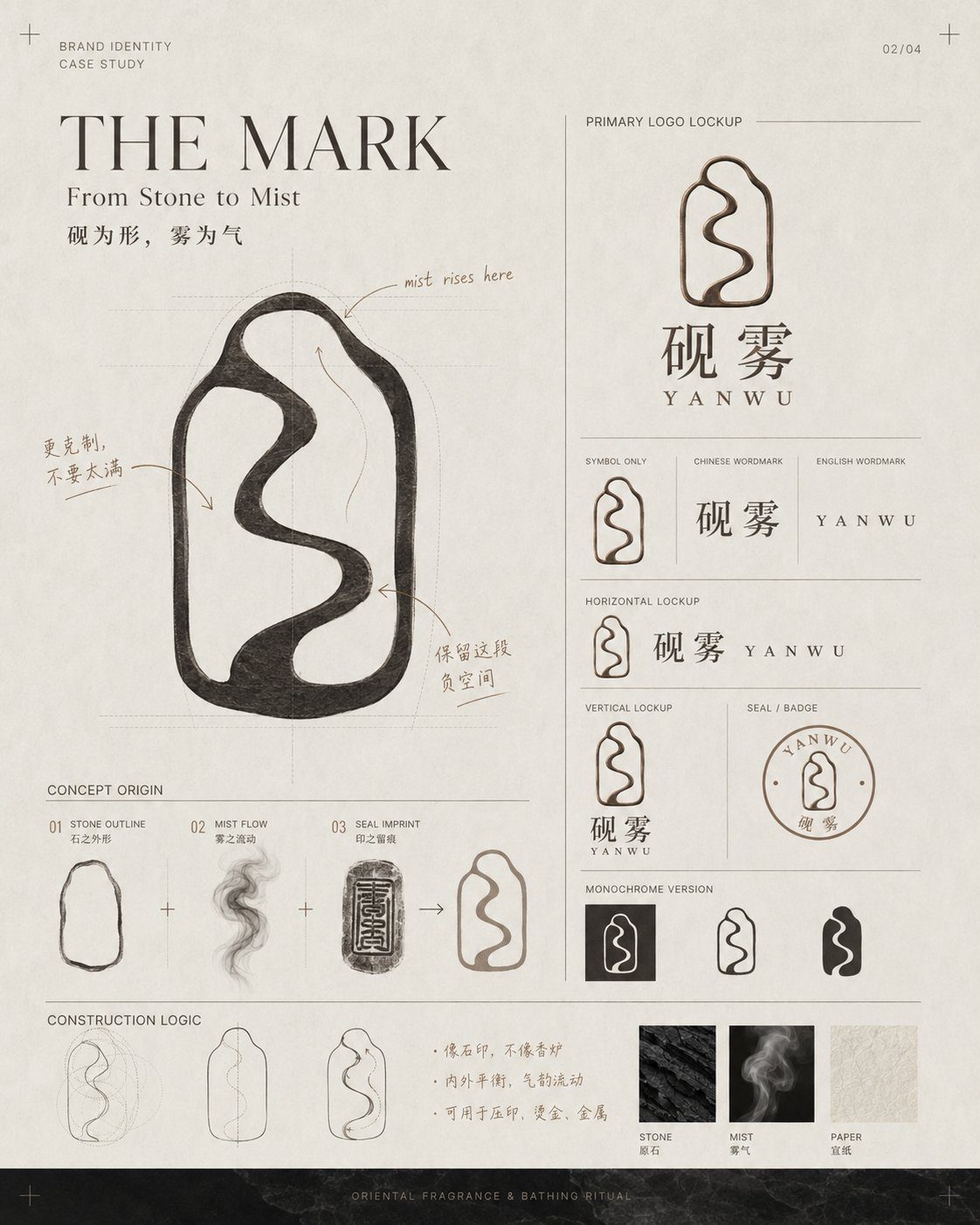
Place an oversized logo symbol at the visual center and show the full logo, Chinese and English wordmarks, horizontal and vertical lockups, simplified versions, concept source sketches, negative space, and structural relationships.
Add a few hand-drawn outlines, arrows, circles, and designer handwritten notes so viewers understand why the logo is designed this way. The page should feel research-oriented, but not like a complex engineering diagram or traditional VI table.

Image 3: Brand visual language and design system.
Show primary colors, secondary colors, typography, materials, photography language, cropped logo details, and supporting patterns.
Colors need to connect with real materials such as stone, paper, metal, glass, plants, or fabric. Supporting graphics must be extracted from the logo silhouette, internal curves, negative space, or strokes, without adding unrelated decoration.
Use a layout that combines an orderly grid with free collage, including large typography, vertical text, fine lines, and a few handwritten marks.

Image 4: Brand applications and experience scenarios.
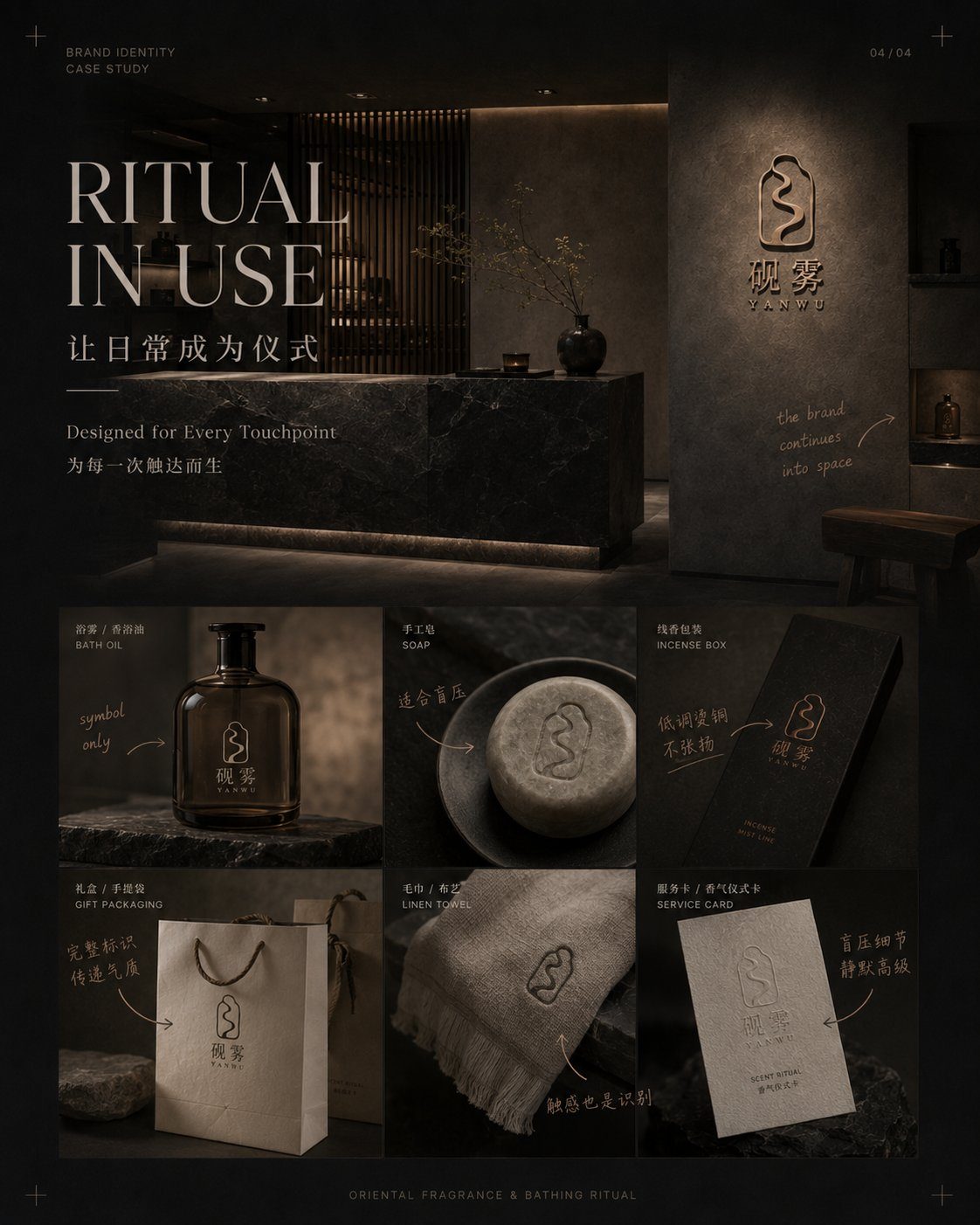
Show how the brand enters real products, packaging, paper goods, textiles, and spaces. Choose 5 to 7 reasonable touchpoints based on the industry, such as the main product, gift box, shopping bag, card, label, uniform, towel, metal plaque, storefront, reception desk, or wayfinding.
Use a structure of one large product or spatial key visual plus 4 to 6 application details. The full logo, independent symbol, and supporting patterns should be used in layers. Do not print the full brand name repeatedly on every item.

Overall visual requirements:

The complete set should use a design language combining premium brand proposals, editorial magazine design, art direction boards, and modern visual identity case studies.

Every image must include:

- A striking large main title
- A short subtitle
- One core explanatory sentence
- 2 to 4 keywords or information labels
- 2 to 4 meaningful handwritten notes
- A clear visual center
- About 25% to 35% whitespace

The main title should participate in the composition. It may be enlarged, cropped, offset, arranged vertically, or interwoven with images and the logo. It cannot be a plain page header.

Handwritten marks can use short phrases, arrows, circles, underlines, or simple sketches to explain the logo, typography, colors, materials, and process. Handwritten content must be short, clear, and meaningful. Avoid meaningless garbled writing and excessive scribbling.

All four images must use the same brand name, logo, typography, color palette, materials, photography atmosphere, margins, and guide lines, but the layouts must not be identical:

- Image 1: Large key visual and mood collage
- Image 2: Oversized logo and structural research
- Image 3: Color, typography, and material system
- Image 4: Product, space, and application rollout

Avoid ordinary PowerPoint pages, simple moodboards, traditional VI tables, stock mockup collections, neatly repeated grids, long body copy, information crowding, low-quality 3D materials, cheap-looking gold, color drift, and logo structure changes.

Output requirements:

Directly generate four independent 4:5 vertical images. Do not merge the four contents into one collage, and do not output image prompts first.

Generate them in this order:

1. Brand worldbuilding and concept cover
2. Logo concept and symbol generation logic
3. Brand visual language and design system
4. Brand applications and experience scenarios

If only one image can be generated at a time, start directly from Image 1 and continue generating Images 2, 3, and 4 using the same locked logo and visual system. Do not re-plan or change the design direction.