aiiStudio
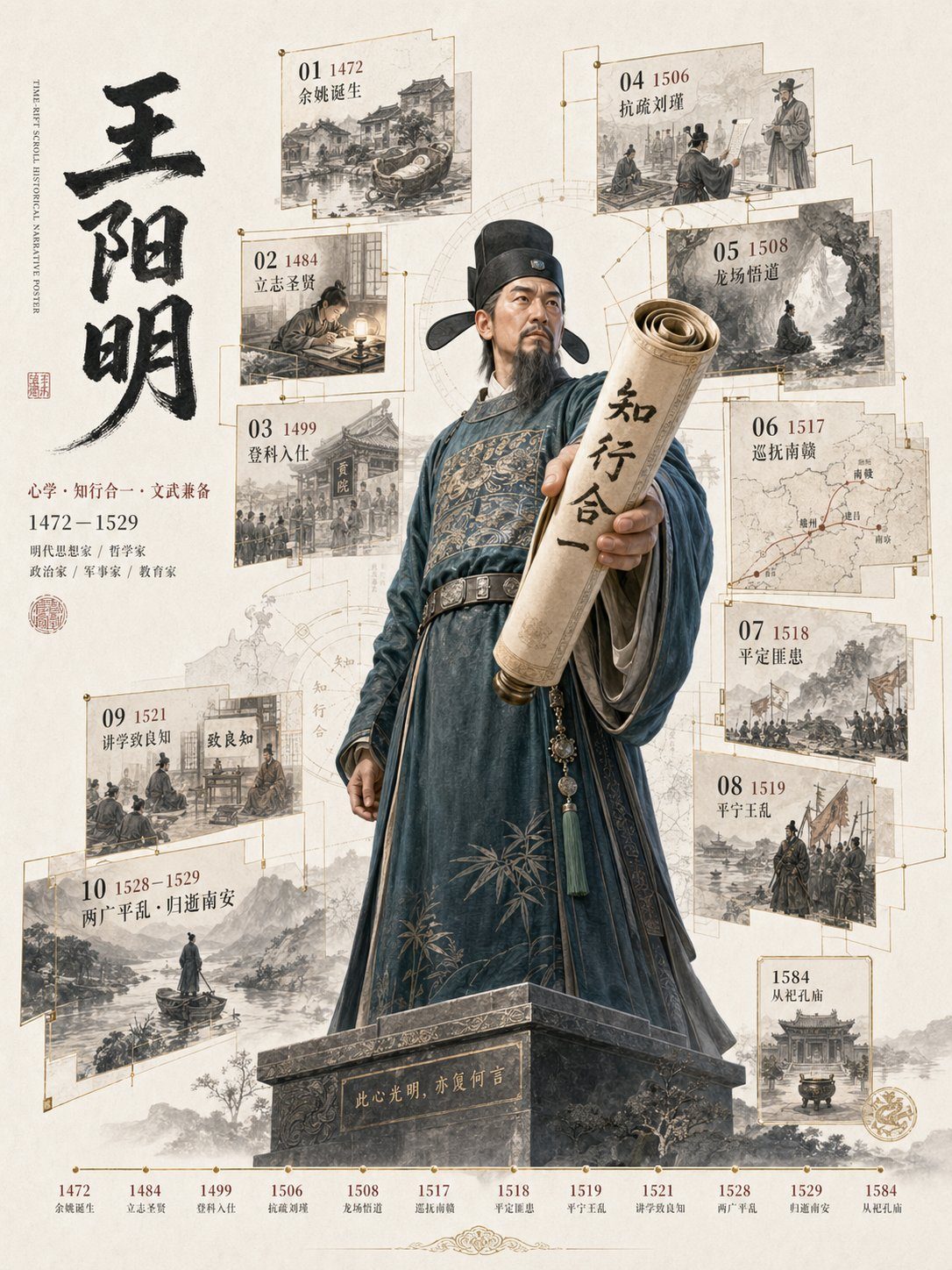
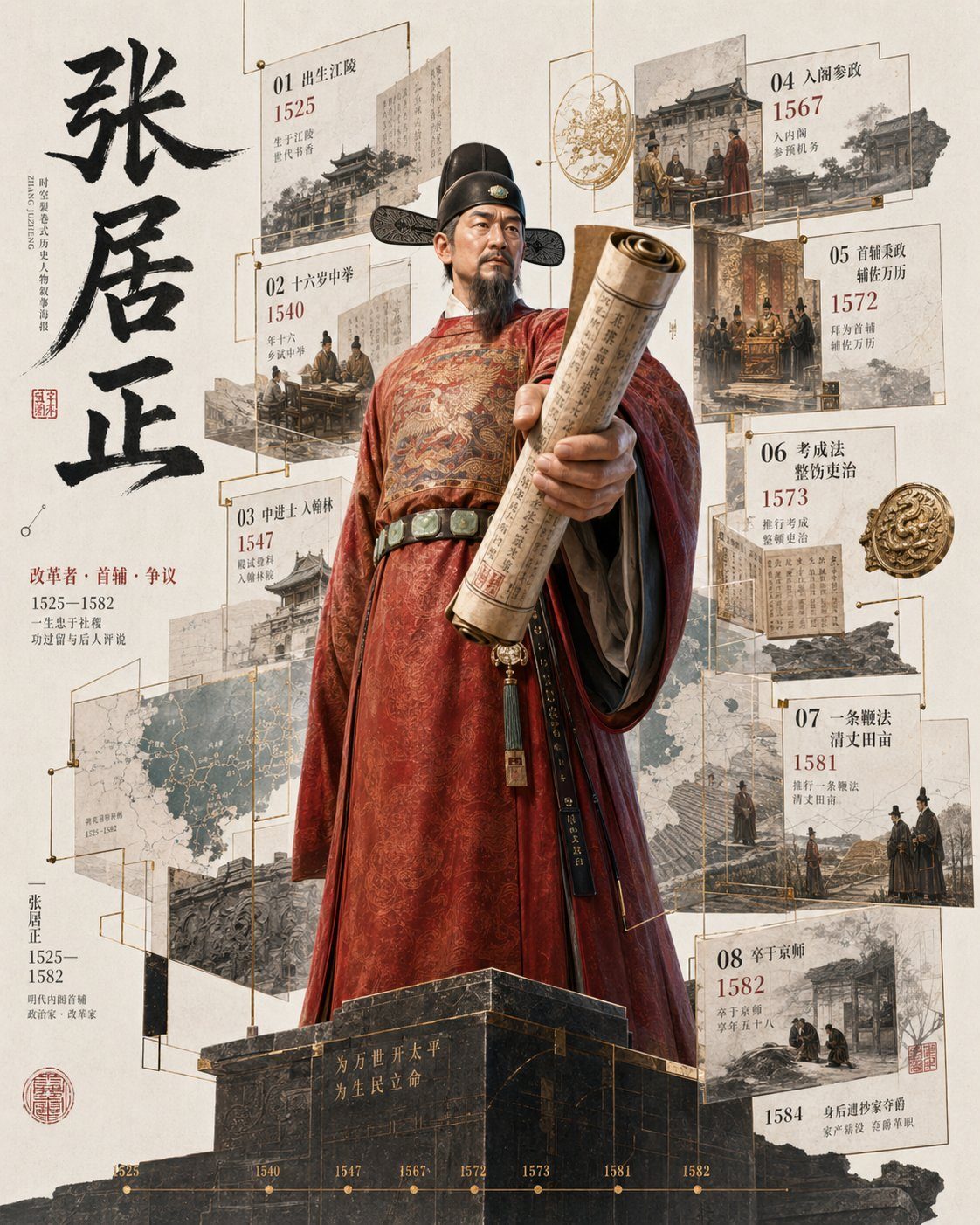
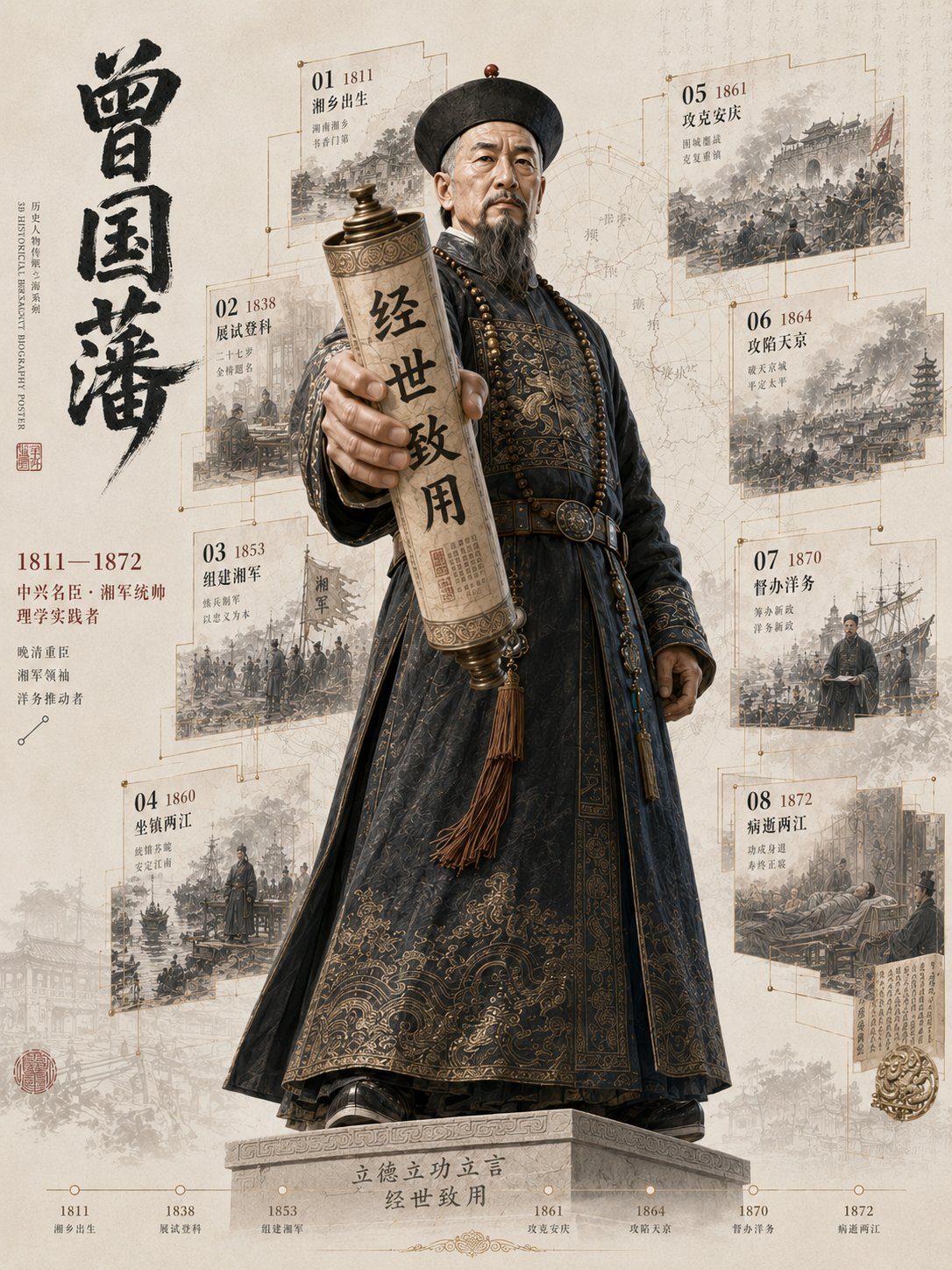

Create a high-completion "Historical Figure Breakout Statue Archive / 3D Historical Breakout Biography Poster".

[User Inputs]
Subject figure: [PERSON NAME]
Identity: [Emperor / General / Statesman / Thinker / Writer / Reformer / Military strategist, etc.]
Era: [Dynasty / historical period]
Core keywords: [Unification / Reform / Loyalty / Unity of knowledge and action / Northern Expedition / Institution / Mind School / Golden Age, etc.]
Dominant color palette: [Black-gold-red / cyan-blue-gray-gold / dark red and ink gold / iron armor deep blue, etc.]
Aspect ratio: [3:4 vertical]

This is not an ordinary history poster, but a high-completion biographical historical-figure poster built around a core structure of: a central full-body 3D historical figure + breakout-forward action + lightweight floating clusters of historical events around them + a slim chronological timeline at the bottom.

The center must be a complete, full-body, standing 3D historical figure, the most important main subject of the entire image, with strong volume, sculptural quality, monumental presence, and historical aura. Clothing, crown/hat, armor, patterns, belt, footwear, and accessories must match their era and identity. The overall figure should be realistic, weighty, with cinematic visual impact. Beneath their feet should be a light yet stable monument-style pedestal that supports the figure without weighing the composition down.

The figure must not simply stand passively, but perform an obvious "breakout-forward action". Hands, arms, or a key prop (jade seal, imperial edict, scroll, spear, long sword, military tally, court tablet, map, book scroll, etc.) must extend toward the viewer, creating strong foreshortening, depth, perspective compression, and a 3D impact that breaks out of the frame. Important: the forward-extending key prop must be fully visible and clearly identifiable, not cropped to just a sliver.

Arrange 6 to 10 key historical event nodes around the figure. Do not render them as heavy, regular, tile-aligned cards, but as "lightweight, floating, multi-orientation, semi-transparent" historical event clusters. Each node may consist of 2 to 4 sub-fragments including a number, year, event title, brief description, small historical scene image, plus thin gold lines, open-ended frames, node dots, annotation lines, etc. The overall feel should be like historical archives dissected into airy time slices floating around the figure, not normal info-card layouts.

These event clusters should have different orientations and spatial perspectives: some tilted left, some tilted right, some turned inward, some flipped outward, some higher, some lower, with front-back depth layers, and may be slightly occluded by the figure's arms, robe, or weapon to create spatial depth. They should have a glass / acrylic feel, faintly glowing edges, incomplete frames, and slight stacking offsets — informationally rich but visually light, never overpowering the central figure.

On the left side of the composition, place a large title with [PERSON NAME], using a font with oriental historical character — calligraphic, stele-carved, or ink-brushed feel. Beside it, add birth/death years, identity tags, keyword summary, and a single sweeping subtitle. The title area should feel stable, simple, and restrained — not crowded.

The bottom must include a light, simple, refined horizontal timeline connecting the important years of the figure's life, with corresponding relationships to the surrounding event clusters. The timeline should feel more like a curatorial guide line, museum time ruler, or historical index line — use thin gold lines, small dots, clean years, small text annotations, and a few decorative nodes. Do not turn it into a heavy black bar or large bottom info block.

The background should use cream-white rice paper, antique paper, old archival paper, or a light museum-wall texture as the base — overall low-saturation, clean, and restrained. Optionally add faint map textures, ancient architecture silhouettes, document fragments, seals, gold connector lines, annotation lines, nodes, territorial outlines, etc., to create a light, rational sense of a historical archive exhibition.

The entire image must establish a clear contrast:
The central figure: weighty, realistic, three-dimensional, with strong light/shadow and volume.
The surrounding historical nodes: thin, transparent, floating, faintly glowing, refined, rational.
The figure's action: breaking forward, breaking the frame, full of spatial impact.
The bottom timeline: light and restrained, only to organize the information.

If any requirements conflict, prioritize in this order:
1. The central figure must be a complete full-body view.
2. The forward-extending prop must be fully visible with strong 3D impact.
3. The surrounding event clusters must be light and floating, not heavy cards.
4. The central figure stays "heavy", the information system stays "light".
5. The bottom timeline stays lightweight, clear, and does not weigh down the composition.

If the model struggles to precisely control large amounts of small text, prioritize legibility for the person's name, years, numbers, and event titles — short descriptions can be simplified or left as placeholders for later typesetting.